Announcing: Call My Name, Call Me Home
30th September 2026
This short essay, which reflects on the impact and influence of H.G. Wells’s iconic novel, was written for the War of the Worlds digital programme.
There is a delicious irony to H.G. Wells’s The War of the Worlds (1898). The author’s tale of destruction and societal collapse has produced an enduring legacy, building narrative tropes and iconic imagery that have held fast in the century-and-a-quarter since its conception and that continue to shape stories today. When we think of alien invasion narratives – of which this is one of the earliest and most prominent – it’s likely that what we conjure in our minds is inspired, knowingly or otherwise, by the beats and descriptions of Wells’s novel. Its descriptions of Martians and Mars as the invading enemy, Tripods, heat rays and post-apocalyptic landscapes and societies are pioneering signifiers – shorthand language for genre(s) and stories aplenty.
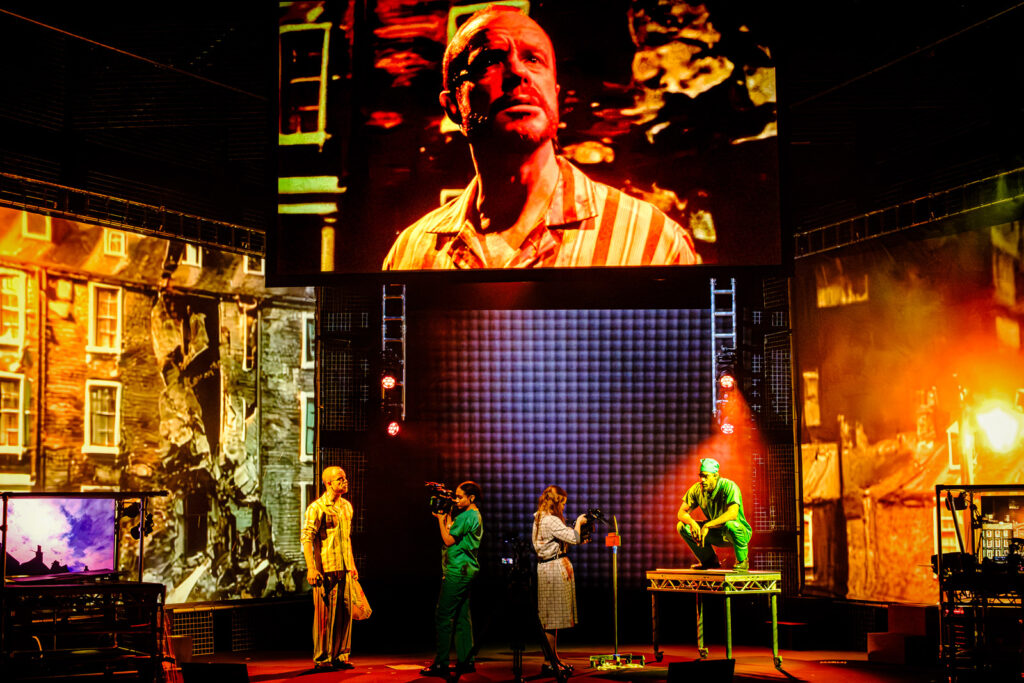
Yet, while there might be familiarity in any close encounter with The War of the Worlds, time has not dulled its impact into comfort. It is still so thrillingly disruptive and chilling, as relentless in its potency as it is in its longevity.
Paradoxically, this is because of Wells grounding the otherworldliness of his narrative in the reality of the world around him. His story unfolds in allegory with the contemporary sociological, political and cultural concerns of the time and place from which it sprang from. Written at both the turn of the century and the closing out of the Victorian era, The War of the Worlds arrives on the precipice of uncertainty, and the ‘battleground of fear and curiosity’ in response to that unknowability.[1] (Indeed, the novel’s original publication as a serialisation in Pearson’s magazine from 1895-1897 even leans into this state of flux with readers kept in suspense, both in fear of what lies in store and keen to find out more.) As such, the novel is a quintessential slice of fin-de-siècle literature, notable particularly at the end of the nineteenth century for its preoccupation with the state of the nation, from complacency to the fear of a society’s disintegration and end.
In his writings on apocalypse, Frank Kermode writes that apocalypse fictions ‘underlie our ways of making sense of the world from where we stand, in the middest’.[2] In other words, with a view of all (or as many) contributing factors at once. Wells’s story, though deceptively straightforward, places its contemporary reader in turnabout, looking at the Martians as representative of the threat of foreign invasion and occupation from European rivals looking to usurp Britain, to Britain’s own role in the act of colonisation and its identity and actions as Imperialists stepping into the lands of others. Similarly, the threat of ever-evolving technology, looming large in the form of the seemingly indestructible Tripods and their death blasts, suggest inevitable, nihilistic death by mechanical creation. All this whilst running parallel with the surge in industrialisation in Britain’s towns and cities during the nineteenth century, skylines anxiously shifting with the rising up of chimneys and factories billowing smoke and hot with flames.
While this appears to tether Wells’s story to the Victorian era immovably, it instead can be viewed as a historical precedent – a template others might draw from, move and use for looking closely at their own surroundings in another time and another place. Though Wells roots his narrator – and, by extension, his reader – in the centre to look outward at what is happening, the character is constantly moving from place to place in his attempt to find a safe haven and survive. In itself, this is both an early template for the haunted pilgrimage of similar apocalypse narratives (The Road, The Walking Dead, and so on) and the opportunity for Wells to have fun, injecting bone-deep satire and jet-black humour into the uncomfortable individuals gone mad with the absence of structure and security. It is also a premonition of The War of the Worlds’s own ability to progress. As Kermode writes, ‘Apocalypse and the related themes are strikingly long-lived; and that is the first thing to say about them, although the second is that they change’.[3]
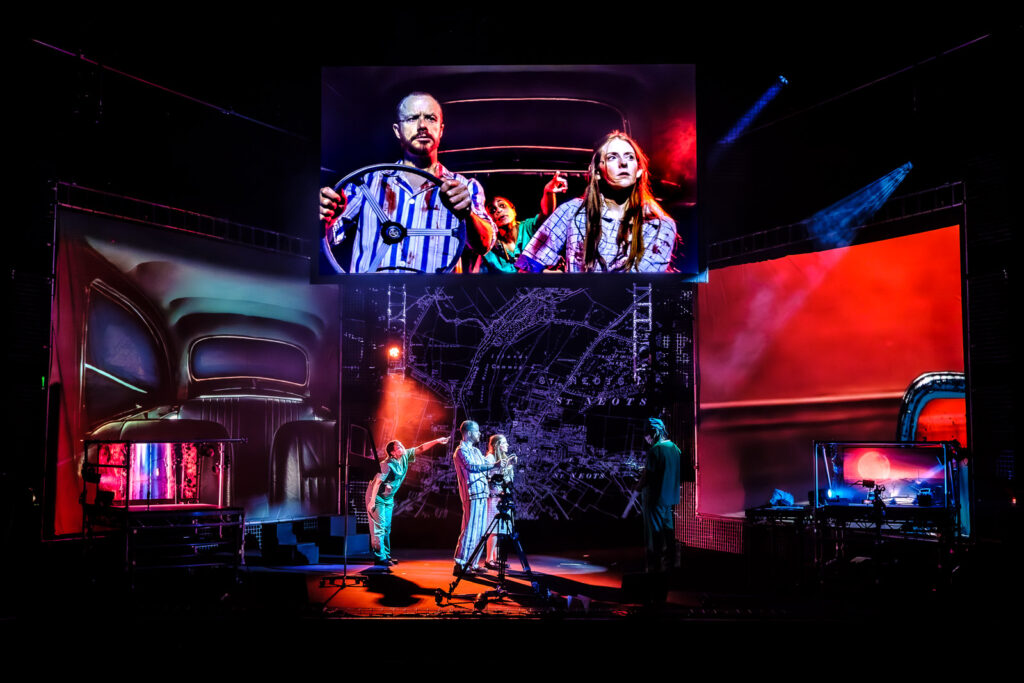
Orson Welles is responsible for arguably the most scandalous adaptation of Wells’s novel in a live radio broadcast on 30 October 1938. Welles, then just twenty-three years old, was so convincing, so meticulous, so committed in his attention to detail as both director and performer that numerous listeners tuning in to CBS Radio Network that evening became convinced that a Martian invasion really was happening across America.
Inspired by previous radio hoaxes and audio dramas, it was Orson Welles’s intention to blur the lines of reality and fiction. He had worked with adaptor Howard Koch in the week running up to broadcast, relocating the UK setting to the East Coast of America and presenting it as a simulated newscast, with ‘breaking news’ bulletins interrupting seemingly regular programming. Commercial breaks were kept to a minimum, with the first coming after the descriptions of the fall of New York City. Complaints and media backlash followed, along with a (half-hearted) public apology from Welles.
Aside from cementing his reputation as a mercurial creator, Welles’s production demonstrates the power of media in retelling the original story. Whilst it is likely that the extent and truth of the panicked reaction was and has been mythologised, Welles’s recreation nevertheless delivered a warning about the power of reckless and inaccurate broadcasting – keenly felt as fascism rose to power in Europe.
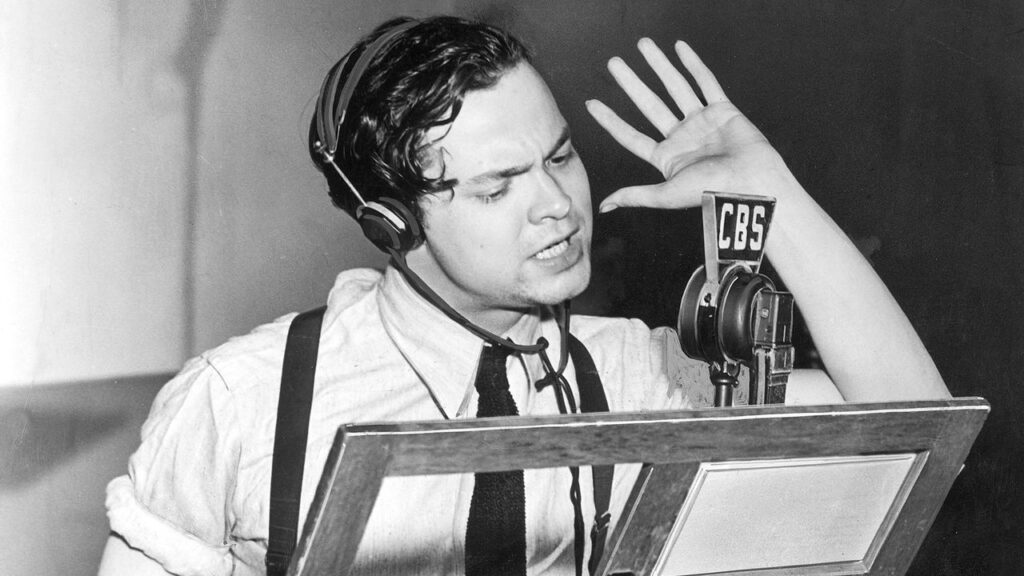
Film adaptations followed suit in updating or transporting the source material. The first cinematic version, directed by Byron Haskin and starring Gene Barry, was released in 1953. Set in California, the film leant into nuclear panic, introducing the atomic bomb to the story and the potential worldwide annihilation that might be the result of the Cold War. Meanwhile, Steven Spielberg’s 2004 blockbuster version, starring Tom Cruise, used the story as a lens to consider the feeling of uncertainty of post-9/11 America – and as a more serious, scary version take on aliens, which until that point had been part of the director’s family-friendly oeuvre.
Other pieces of media have also had their fun with Wells’s blueprint: Roland Emmerich’s Independence Day (1996) updated nineteenth-century fin-de-siècle to Y2K tech anxiety (amidst very big explosions, of course), even putting a cheeky spin on the novel’s original ending in homage to its apparent influence. Elsewhere, Danny Boyle’s 28 Days Later (2002) swapping aliens for infected people, charted a similar journey of encounters for its protagonists in their attempt to reach a safe place, even meeting a group of British squaddies with a leader driven so mad by the collapse of order that he makes it his personal mission to reinstate it in the new world around him.
There are more, many more allusions to The War of the Worlds out there, often in the strangest of things and, of course, though rarely, also apolitically – or as apolitical as any form of art can be. But regardless of whether the intent of an adaptation or homage is as intrinsically tethered to the world around it as the original, there is no doubting that the wheels keep on turning for Wells’s story, that there is still diesel in the tank for more and more journeys into the unknown. Best to buckle up.
Dr. Lauren Randall
(originally featured in the War of the Worlds programme)
All production photos by Ed Waring
[1] H.G. Wells, The War of the Worlds (London: William Heinemann, 1898), p.38.
[2] Frank Kermode, The Sense of an Ending: Studies in the Theory of Fiction (New York: Oxford University Press, 1967), p.29.
[3] Ibid., p.29.
30th September 2026
If you have enjoyed watching a show or taking part in one of our activities, and would like to support our future work, you can make a one-off financial gift. Please click below.