Announcing: Call My Name, Call Me Home
30th September 2026
We’re delighted to welcome Abby Clarke into the company for War of the Worlds as the show’s Set and Costume Designer.
We had the pleasure and privilege of working with Abby on our outdoor performance piece All Change, which opened the S&DR 200 Festival in March 2025. Having seen her navigate live performance, ensembles, projections, recordings and drones in the changeable North East air, we were thrilled to be able to collaborate with her again in warmer conditions – but with no let up on the technical challenges and ambitious scale!
As the show embarks on its tour, we spoke with Abby about her inspirations and process for designing such a visceral production.
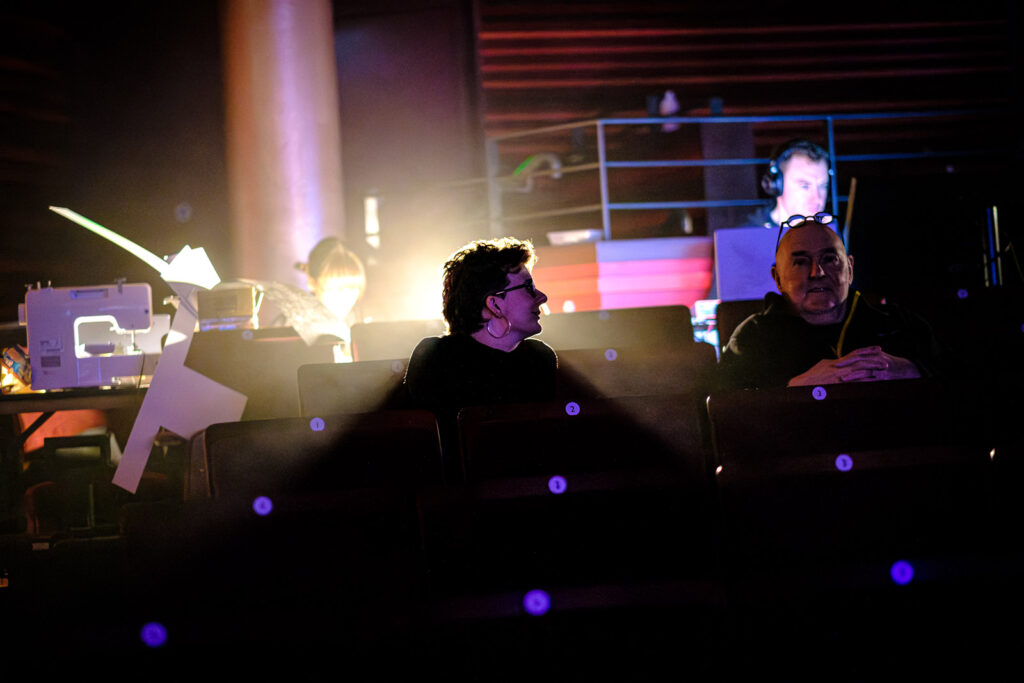
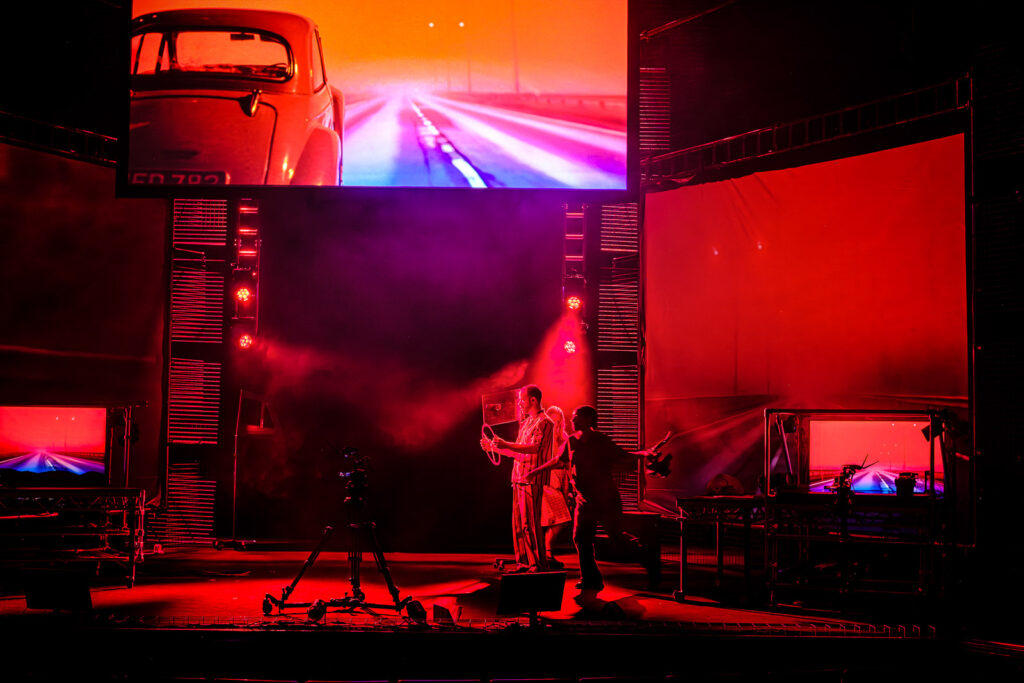
The starting point for any design journey always comes from both the text and conversations with the rest of the team- right from the earliest conversations Pete [Brooks], Andrew [Quick] and Simon [Wainwright, imitating the dog’s co-Artistic Directors] knew they wanted to create a world on film that was partly made from miniatures and models, and also that we wanted the world to be grounded in 1968, at the time of the Enoch Powell rallies.
Early on, as well as Andrew’s script, I spent quite a lot of time reading and listening to the original text by H. G. Wells – there are a lot of recent adaptations of War of the Worlds and so it was helpful to go back to the core text to find the original ideas and descriptions of the landscape, the journey, and the tripods.
When I’m designing for any production I’m always asking myself two questions: how does this space best practically serve the performance, and what can the design communicate to the audience about the story we are telling?
With imitating the dog’s shows, innovative use of technology is at the forefront of their way of storytelling and so facilitating these elements becomes a big part of the stage space. Working with Simon, we’d discussed what we needed for the projection and Pepper’s Ghost elements – at least one back-projected screen for visual backdrops, and another light-absorbent black screen that could work as a backdrop for the Pepper’s Ghost effect.
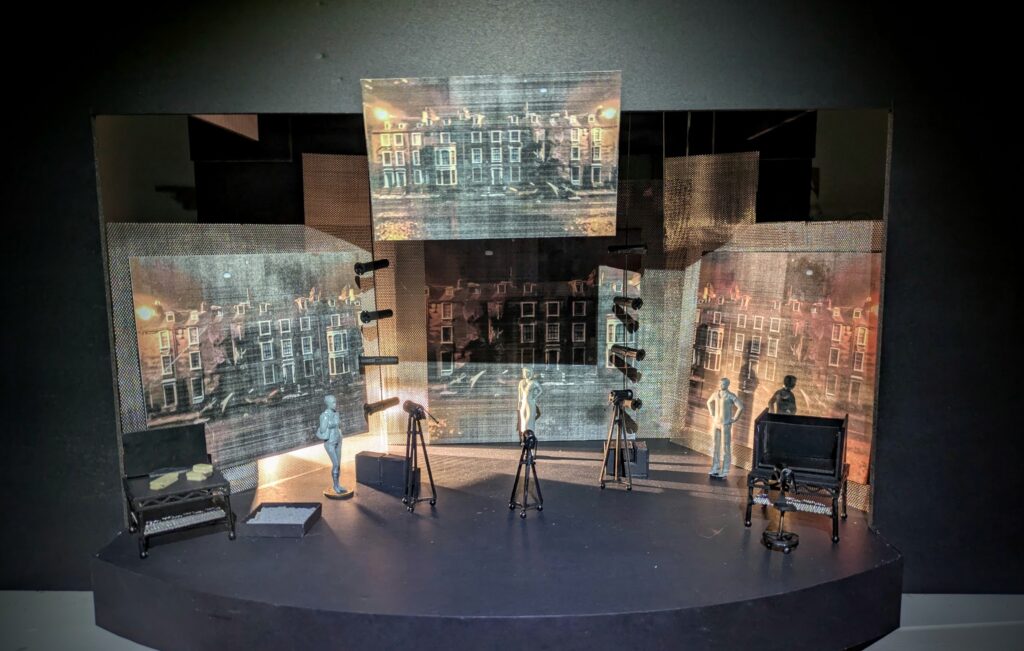
In the second R&D we used a trapezoid structure of two angled side screens and one black backdrop to help shift between the different shots. Because it’s important not to light the floor when creating the Pepper’s Ghost illusion I’d suggested gaps between these screens to allow for sidelighting to pick up the performers. Once we’d found a layout that supported the technology I could work on how the set could reinforce some of the themes and ideas that had been developing in the piece.
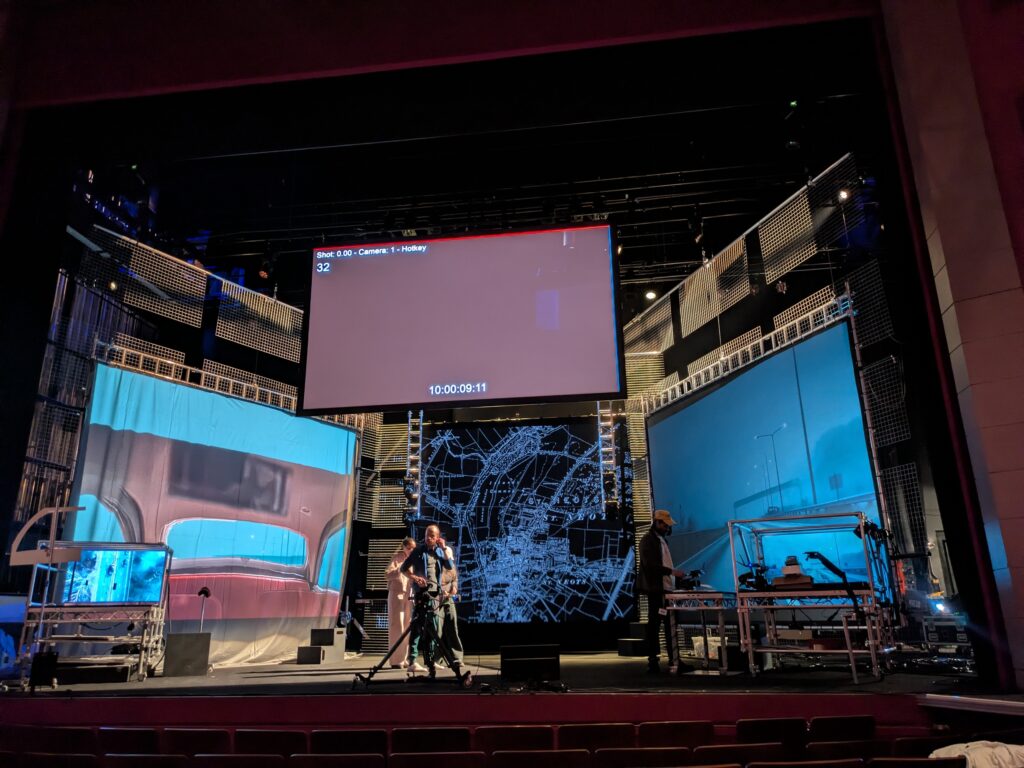
This trapezoid space felt very cage-like, and embracing that prison-like structure felt fitting for creating the world of Travers [played by Gareth Cassidy]. His experience in the play is a paranoid fantasy about immigration, but also a sort of punishment for his actions at the rally, with the other three characters acting out the roles of judge, inquisitor, punisher. Travers is imprisoned both within the narrowness of his own mind, and within the punishing machine of his nightmare. This idea of imprisonment and punishment also visually plays into the realities of brutal immigration systems – both historical and contemporary images of people trapped behind mesh fences in detention centres that are part of current political conversations across the world.
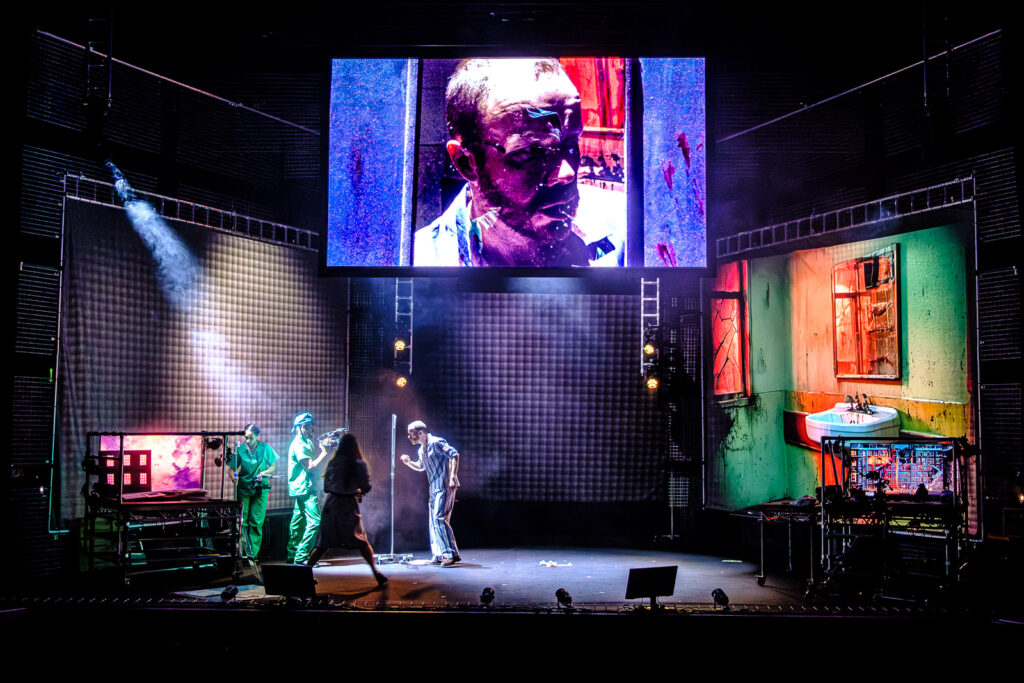
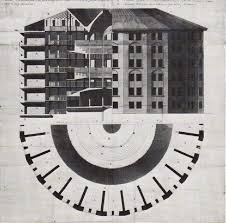
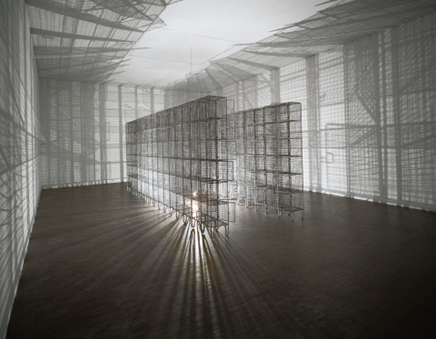
Out of those ideas I’d been thinking a lot about Jeremy Bentham’s panopticon – a Victorian concept of a circular prison, with a central anonymous watchtower at the centre where there is always the fear of being watched, which Foucault writes about in his essay Discipline and Punish. The tripod – both the alien machine and the camera! – feel like a version of this anonymous watchtower, where Travers is always being observed. I’d also looked at Mona Hatoum’s Light Sentence – a sculpture exploring imprisonment comprised of a moving lightbulb within a structure made of mesh lockers, creating these changing shadows in the space. With this in mind, steel mesh was the right material to complete the world, feeling both medical and mechanical, creating this pixelated cage of Travers’ mind where he is trapped as the nightmare of the invasion unfolds.
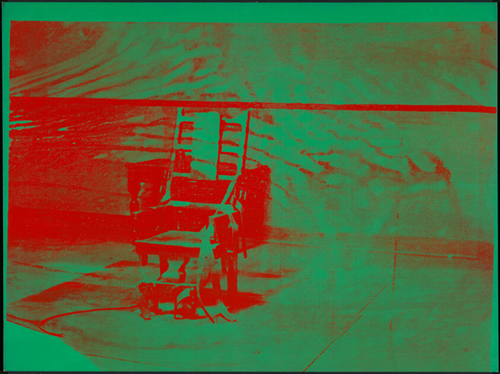
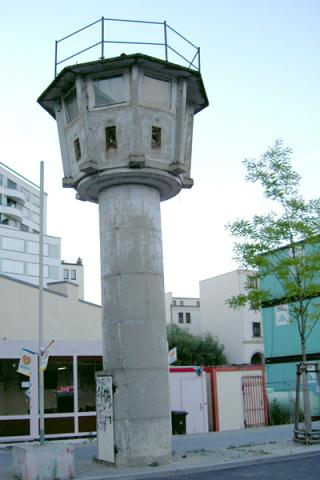
For the model and digital world I’d been looking at 1960s architecture and artists. Andy Warhol’s Electric Chair print series – this sinister, grungy, monochromatic image of death and punishment that he prints and reprints with vivid electric hues – was one of the images me and Si looked at when initially exploring the video aesthetic. Almost all of the models are completely greyscale and then coloured with Si and Davi [Callanan]’s video design and Andrew [Crofts]’s lighting. When it came to the aliens themselves, it felt like these should be constructed from human ideas of punishment and paranoia as well – the tripod machines in the show are based on photographs of 1960s Berlin watchtowers.
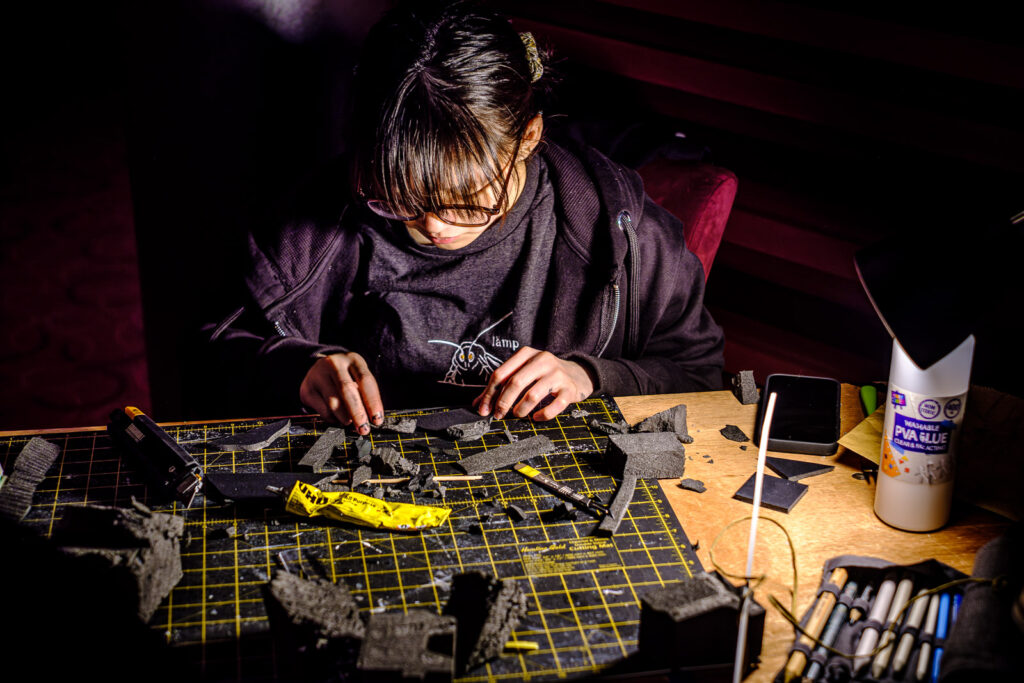
While the set was finalised earlier on in the process, and a few models had been made ahead of time, a lot of the model design elements and props were made during the rehearsal weeks as the show developed and we made discoveries about what worked and what didn’t for the show. For each scene there was a lot of sketch model making with rough pieces of card to understand what would work for the shot.
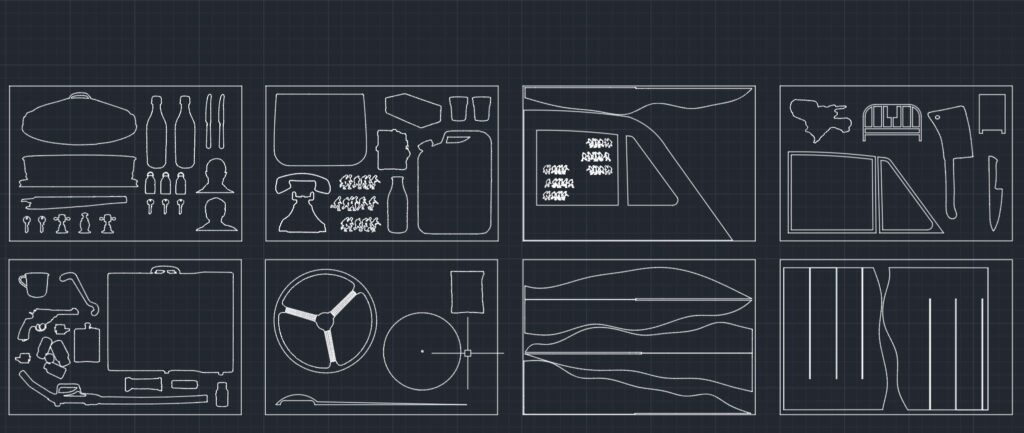
A big part of the final aesthetic is these 2D cut out props that Travers interacts with as the real-scale elements of the design. Even though Pete and Andrew had been looking at collage as some of the references for the show right from the start, we actually didn’t settle on the 2D prop idea until the second week of rehearsals. The idea partly came out of the white card cut outs we’d been using to test out shots. We found it was much more playful and visually interesting and it played into this idea of Travers constructing this paranoid world around him, almost out of the newspaper clippings and video footage that you see in the show. Practically as well, with well over 100 props in the show, it meant we could actually fit all the elements on stage!
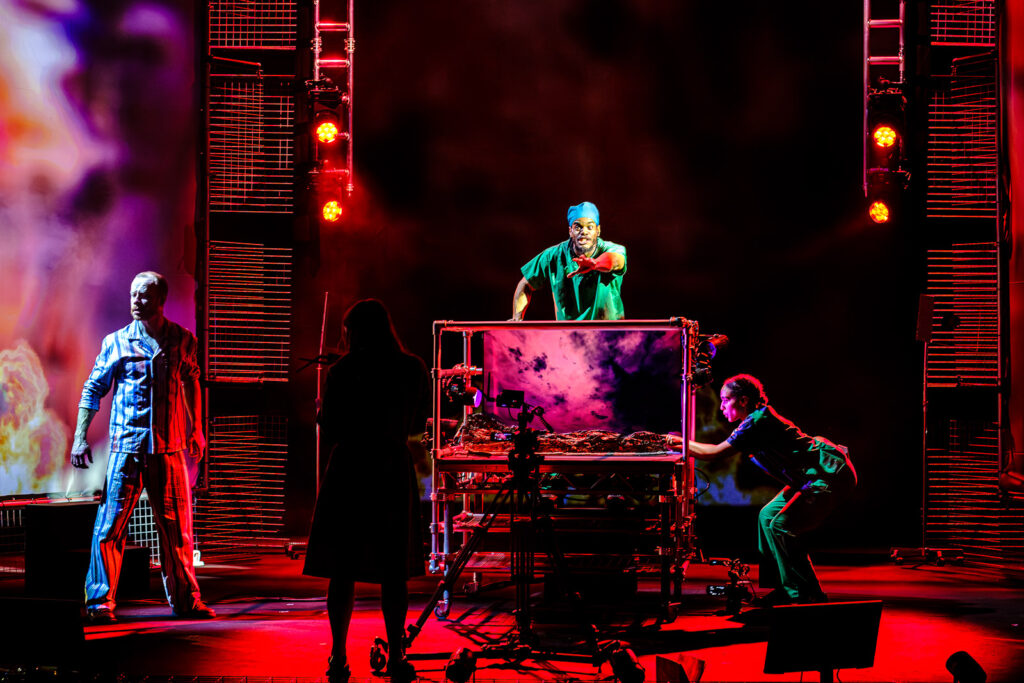
One of the biggest design changes in the process was the costume – Travers’ costume was set from the beginning but I’d originally imagined that the three medical staff who manipulate the world around Travers would be in 1960s civilian clothing, initially with white lab coats and then would have small costume additions throughout as they inhabited different characters. But we found that it both felt too theatrical as a convention and also that the performers wouldn’t have time for those changes amongst the live filming, setting up shots and acting. There was a lot of discussion with Pete and Andrew about the right approach. Late on in the process we tried 1960s hospital scrubs instead of lab coats and this surgical uniform made much more sense of Morgan [Bailey], Amy [Dunn] and Bonnie [Baddoo]’s characters as these hallucinations of Travers nightmare. Aesthetically it felt really right as the green with red blood stains knitted together with the colour grading on the video design and the lighting design. It did mean saying goodbye to some beautiful period costume items though.
You’ve got to be prepared to be a bit ruthless when it comes to editing. Some of the very first models from the R&D are in the show, others got cut the day before we opened, and some never made it on stage at all – it’s good to not be too precious: even if it’s taken hours to make, if it doesn’t serve the story, it’s out!
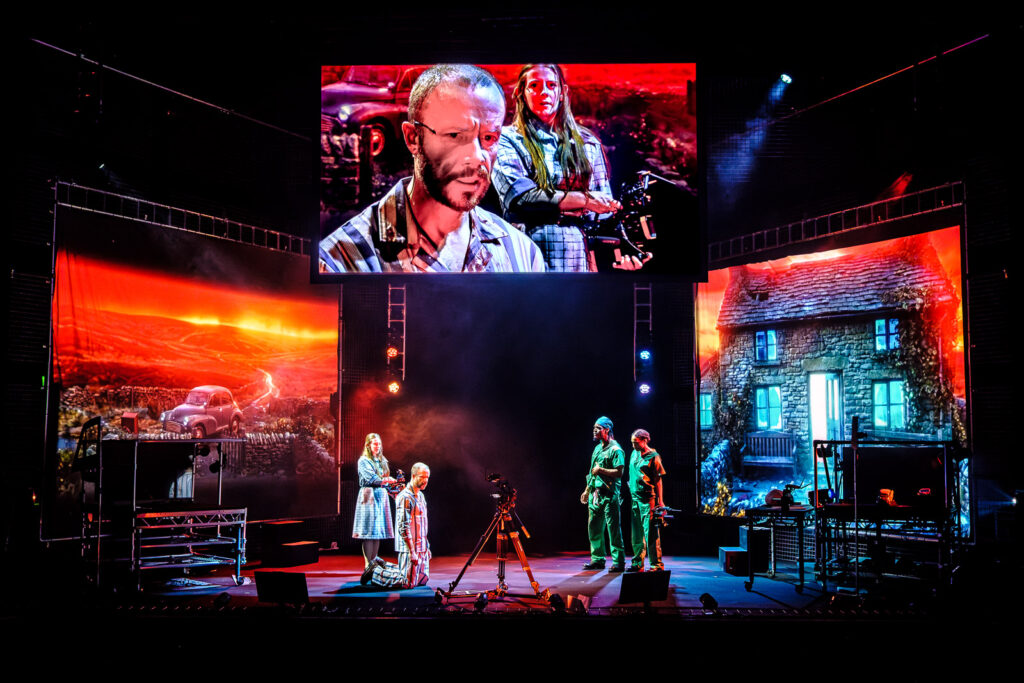
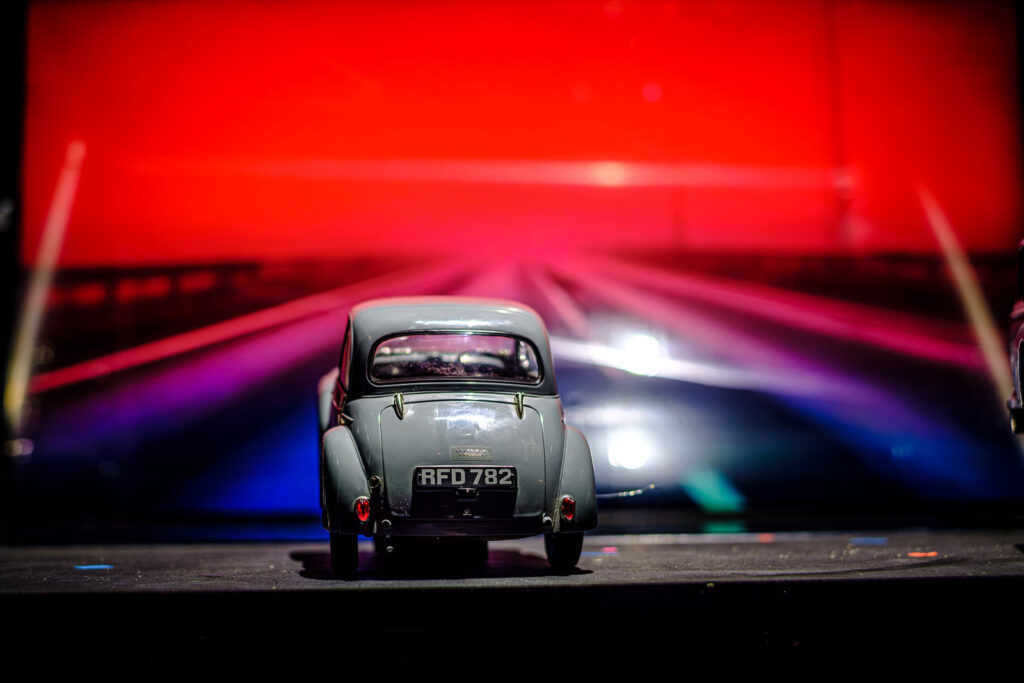
A big challenge of the show is trying to give the audience the sense of this full destroyed landscape – London on fire, subway tunnels, ruined churches, a world in ruins – with just four performers on a stage. Close-ups and mid-shots against a backdrop are easier to do but wide-shots of Travers in this ruined world are much more challenging. The way the team wanted to approach this was through scale elements, using models and a digital Pepper’s Ghost – a Victorian theatre trick that creates a hologram effect by reflecting an image of someone against a black background off an angled screen in front of a different setting – which would allow us to place Travers as a small figure amidst this big burning landscape. These elements all use a combination of traditional model elements and technology: a miniature video screen live-streaming the illusion of passengers into a model car, a model of the side of a building with Travers appearing digitally at the window, incorporating the tv screen into the Pepper’s Ghost and using model elements in front and behind to make the illusion work.
It’s technically quite difficult trying to make the Pepper’s Ghost illusion and it was one of the things we focused on in the R&Ds, trying out different materials and techniques. You need a lot of light-control in the model and around the person being filmed, but we also want the technique to be part of the stage picture for the audience so we ended up making an open-frame structure for it that Crofty cleverly lights around. The performers have to be incredibly precise with the filming and staging to make it work but it’s a great effect when it does! With each of the techniques the magic is in combining the live performance, video design elements and the model elements. Pete, Andrew and Si often talk about the enjoyment for the audience being in the disparity between the shot you see on the film and how the performers are actually making it on stage – the model and Pepper’s Ghost elements are one of the extreme examples of this, using these tiny scale elements to create our widest shots.
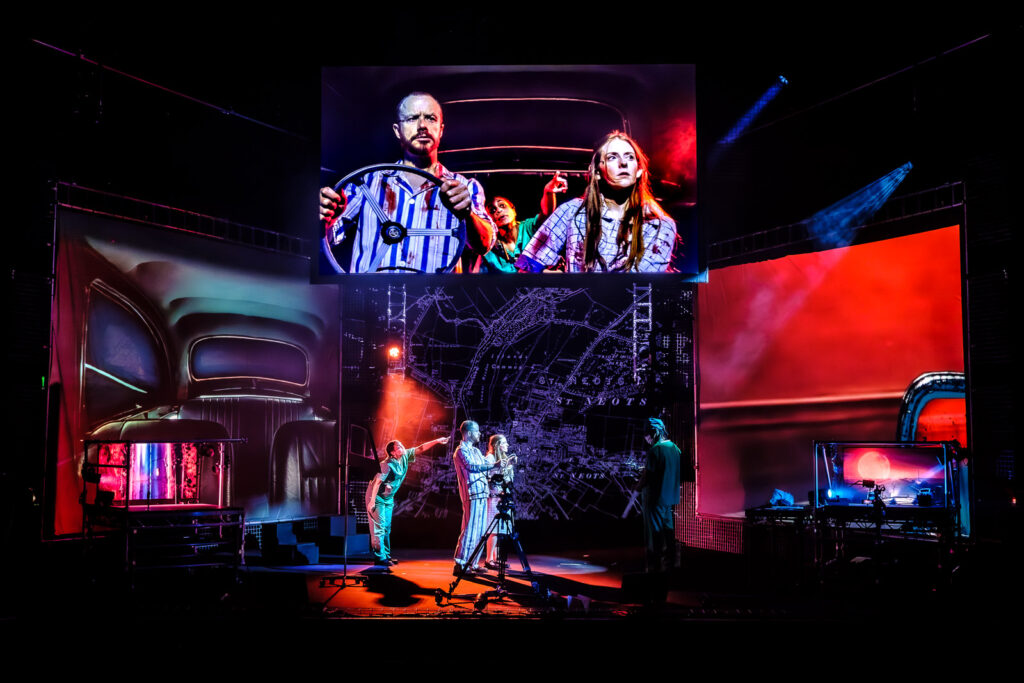
One of my favourite moments of the show is the Battle at Ashford, which came about from playing around with ideas as a team onstage. The model table gets brought out centre stage and we have Morgan as the Artillery Man performing this wild monologue, narrating the war as he looms over a model battlefield. Bonnie and Amy’s shots cut between this miniature battlefield puppeteered with tiny soldier silhouettes on sticks with the Tripods roaming across the screen behind, the artillery man’s monologue, Travers against a backdrop of flame-lit far-right rallies and closeups of a model battlefield from above. It’s a complete blend of old-school theatre tricks, powerful acting, clever camera work, analogue model-making, lighting, sound and video design that is incredibly satisfying to see work and really powerful to watch as an audience member.
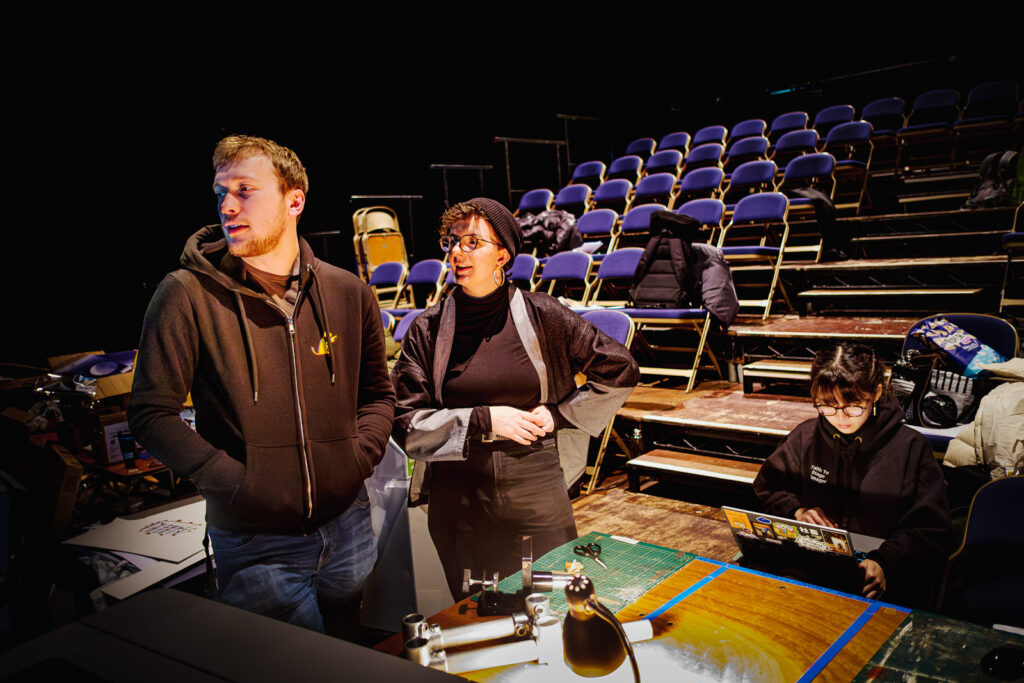
I was fortunate to have brilliant support on the design from Faith from day one of rehearsals. They worked alongside me to help make all of the models, 2D props and set sections you see on stage in the production. It can be a daunting thing to trust someone else to implement your ideas but she was absolutely brilliant at understanding the vision of the production and bringing her own design ideas and creativity to making the props and models. Their graphic design skills with the newspapers and 2D props really came into their own and they really understood the importance of detail for all of the stage elements in the closeups – there’s a moment early on in the show that required a nightmarish sandwich and it’s Faith’s brilliant work making that that gets an audible reaction from the audience every show!
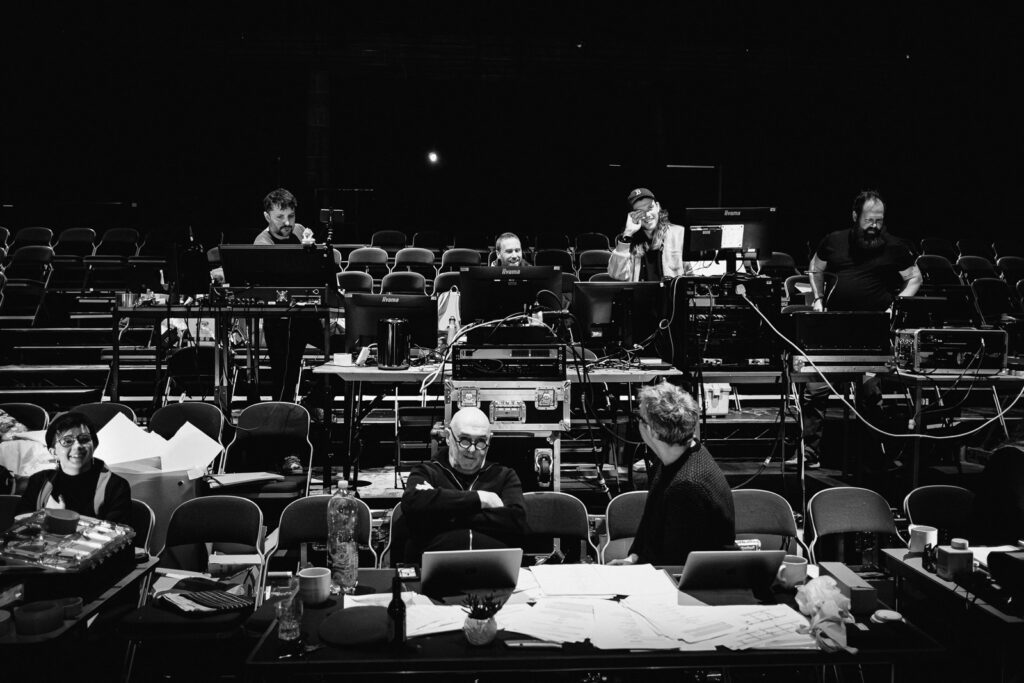
Collaboration happens right from the start of the process – discussions with Andrew, Pete and Si about themes, how to technically make elements work, or how to implement Si’s storyboard, then working with Si and Davi on the style of the model world in the video elements, Si translating rough sketches of the tripods into the digital models used in the show. Lighting was designed into the set from the very beginning, with opportunities for Crofty to light through the mesh panels, from drop down bars, and his use of red and white lighting on the mesh grid above the screens to create a series of sinister St George crosses. We spent a lot of time discussing how best to light the pepper’s ghost and model elements of the design and working with Matt [Carnazza], the production manager to make those rigging frameworks part of the aesthetic of the world in these machine-like tables on either side of the stage. The lighting design is the element that binds the stage, model, and video worlds together on film and then it’s the sound and music that really brings it all together as a full cinematic experience. It’s fascinating seeing how James [Hamilton, Composer & Co-Sound Design] and Rory [Howson, Co-Sound Design & Technician] work in rehearsals – almost live-scoring the visuals as they happen.
One of the many joys about working with imitating the dog is that it’s such a genuinely collaborative room. Everyone is completely trusted to get on with their own job but, in a production process that is like continuous puzzle solving to get the right shot, if we hit a particularly difficult problem, everyone puts their heads together and is welcome to pitch a solution. Collaboration sits right at the heart of the way the show works too: during tech I was discussing with some of the team that the result is an ego-free outcome – each moment of the show and each shot is so reliant on every element working – acting, writing, direction, camera shot, lighting, video design, sound, set, props, costume, tech, music – that there is no room for any department to be the hero, either all the elements work together or they don’t work at all.
30th September 2026
If you have enjoyed watching a show or taking part in one of our activities, and would like to support our future work, you can make a one-off financial gift. Please click below.